Inarticulate ramblings of a management consultant

the day to day experiences of a consultant operating in weird and wonderful client situations

Human Capital

Re-employment, not retention – that’s the name of the game these days

It is extraordinary how age creeps up on you. In thinking about and discussing this blog with a colleague recently, I was suddenly aware of how over the course of 20+ years of work, the nature of my relationship with my employer has changed and more specifically how different it is from the new generation joining the workforce. So, like many of my peers, I’m left with a dilemma. Do […]
Continue Reading →

Have pity for program leaders of a post merger integration – they need your sympathy!

Imagine the following situation: You’re given the challenge to program manage a post merger integration, carried out in the public eye, with all of the details (cost, complexity, high level strategy) broadcast to the world. After a few months, you discover that actually there were a number of other people in the frame for the work, who for one reason or another, couldn’t take up the challenge! You’re given a thousand pages of diligence, written […]

Continue Reading →

Working from home….management’s last bastion of control

The nature of the office workplace has changed almost beyond recognition in the last 30 years. The pace of change in terms of activity, responsibility, speed of communication, access to information and people, and complexity of the ‘transaction’ whatever the company might be engaged in, are all vastly different. Gone are vast numbers of manual tasks and with them activities and roles in the workplace. What is required these days […]

Continue Reading →

Compensation structures – still stuck in the dark ages

As I get older and the needs of my family change, the inherent inefficiency of traditional reward structures becomes more and more obvious. What I mean simply is that the requirements I had of both salary and benefits when I was 20 or 30 are no longer relevant to me, indeed more importantly than their practical purpose is the reduced perceived value that they offer. Much has been written and […]

Continue Reading →

Rights and obligations in the corporate world

I’ve been on a few flights this week and beyond catching up with my favourite shows on the BBC iPlayer (!), the article penned by Malcolm Henry which I reposted last week, seems to be having a disturbing effect on me! Malcolm was describing the debate in Scotland as to the establishment of a bill of rights and his proposition that a bill of obligations would be much more powerful. […]

Continue Reading →

The messy business of retention in merger integration projects

I suspect that the phrase most often heard and rarely delivered against in the transactions world is ‘people are our most important asset‘. It’s right up there with ‘there’s a natural cultural fit between our two companies‘ and ‘this acquisition will be earnings accretive in x years’! Why does the tendency to make statements based on zero knowledge and little chance of delivery continue in a market situation which has […]

Continue Reading →

Mergers and acquisitions are here to stay

It appears that with the renewed interest in deals in the UK (primarily generated by PE), we are once again embarking on a bit of deal mania. I often think that I’ve dedicated the last 23 years of my career to an activity which is entirely defined by the famous quote about madness…to paraphrase, doing the same thing over and over and expecting a different result. Why is this? The […]

Continue Reading →

People versus Process

At the risk of antagonising a number of my close colleagues and friends who work with me currently or with whom I’ve had the pleasure of working in the past, I wanted to ask a challenging question. In 14 years of working with companies going through a post-acquisition integration process, there’s been an outstanding issue which to my mind has never been answered properly – Why is it that process […]

Continue Reading →

The cult of the heroic project manager

I’ve spent a lot of time with a particular client this week and was reminded of the extraordinary nature and power of the heroic project manager species. Let’s define them for a minute…they live and breathe projects, they turn a rather dull programme management reporting task into a real, living document which gives insight. When they engage with a stakeholder, they do an extraordinary thing…they operate at an incredible level […]

Continue Reading →

Culture in transformation...the (not so) new kid on the change management block

For those of you who’ve read the ‘Hard and Soft’ blog, I wanted to return to a theme which has been crucial in my 14 years of consulting…culture.

Throughout this blog, you will find cultural barriers manifesting themselves as specific, definable issues which have specific definable solutions. This is a significant change from 10 years ago in terms of the level of recognition amongst board members. The reasons have probably a lot to do with the growth in cross-border activities, where cultural difference is relatively easy to observe, and in many cases, a growing awareness of people-related challenges in the boardroom.

This development is also reflected in board room appointments. Appointments at board level with titles like ‘Head of Organisational Development (OD)’, ‘Director, OD and Change’, are becoming more frequent and reflect a separation of these set of responsibilities from its traditional, if sometimes reluctant owner – HR. Dave Ulrich also implicitly acknowledges this when he talks about a move amongst HR leaders who now need to take up more of a strategic role within their organisations.

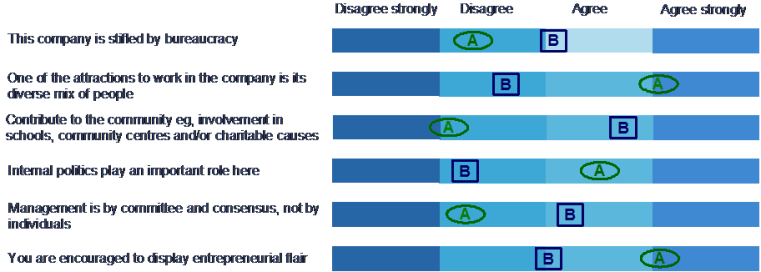
An interesting example of cultural change in a post merger integration project occurred in a transaction involving two retailers in Europe, spanning a number of countries but with a large base in the UK. In this case, the cultural barrier lay between two extremely well-aligned businesses – in other words, in the eyes of the employees, there was a strong linkage between the values which they themselves held and those of the business in which they worked. The potential was there for a very explosive situation as the businesses were significantly different in their approach. To give you some examples of the key difference, I’ve set out above some of the dimensions which we used to measure this difference. In each case, we asked the individuals we interviewed to mark on the spectrum where they saw their organisation (annotated as A and B). Some of the more startling results are seen in the graphic above.
What was fascinating was in certain dimensions where an external party might have seen an issue, for example ‘internal politics play an important role here’ or ‘the company is stifled by bureaucracy’, the individuals on the other hand, saw these as positive traits. ‘Internal politics’ were attributed to a management style which saw influence as a critical tool for changes to take place. In the case of ‘bureaucracy’, individuals considered that to be a key element in the collaborative and consultative nature of the business.

Another interesting result showing up the disparity between the two cultures was the question concerning entrepreneurial flair. For one organisation, this reflected a high degree of comfort with ‘ownership’ – many of the senior and middle management team had been owners of businesses which had been acquired by the company. Their willingness to take risks was based on that experience. For the other company, risk was seen as difficult and unattractive as the impact on the brand was unknown and potentially dangerous.

If these differences had not been addressed, the potential damage to the integration from a productivity perspective would have been very substantial.

The solutions in this case were fourfold:

1) The diagnostic (which had been conducted to get the above results) was communicated to a very broad audience, from executive board to each workstream. In each case, certain decisions were made around the operational implications of the different approaches. For example, at integration team level, agreement was reached on the level of consultation required for decisions. This was critical because the business needed to respond quickly and efficiently – individuals were asked to place themselves in various categories of ‘need to know’, which forced them to realise the nature of their role in the process of decision making. It also created an environment where ‘doing’ first and asking for forgiveness later was acceptable.

The process of releasing the information was in itself a solution. It provided employees at all levels with a sense of the leadership style going forward, and started to develop some trust.

2) The language used in the diagnostic was put into a corporate directory and distributed widely. For both technical and non-technical terms, there had been increasing levels of confusion about what each party meant when they used certain expressions and this helped to clarify. However, from a cultural perspective, certain terms became very helpful, non-pejorative descriptions of behaviour which employees from both businesses used and understood. At a board meeting a year later, the Finance Director used a couple of expressions directly from the diagnostic to explain certain performance characteristics – the fact that this language had transcended into financial management analysis on his part was very powerful for the organisation.

3) The diagnostic informed the process for developing senior executive long term incentive plans. Previously these plans had been created for a relatively small group of people whose interests were aligned. The process of broadening the schemes to have an impact on a group 3 or 4 times the size of the previous structure reflected a new culture within both businesses – one of personal accountability. Not only that, it also created the need for a more formal collaboration and alignment requirement in the combined business which was very important.

4) Finally, the attitude towards innovation and risk also changed considerably. This followed the successful launch of a new product which generated an exceptional return for the newly merged business. As the positive publicity surrounding this product increased internally and externally, a new found confidence towards developing ideas started to surface, and the perceived risk of entrepreneurial behaviour began to diminish.

To summarise, culture remains the key buzz word around transformation and post merger integration. How it is defined, its impact on successful implementation and on some of the solutions – all these aspects are becoming much more commonplace concepts amongst senior management. Ultimately however, there are still some considerable hurdles to deal with, before organisations see the ultimate value arising from culture-related activities.

The first hurdle is that diagnostic alone (particularly e-based diagnostic which has little human interaction) is interesting in a kind of ‘navel-gazing’ way but it needs more than that to make change happen…self-awareness through someone putting a mirror in front of you is a powerful thing, but there needs to be some clarity about what the future looks like. If you’re interested, you can read more about this in ‘To diagnose or not to diagnose’ on this blog.

The second hurdle is alignment. Part of any business strategy around major change or transformation is the need to include alignment – ask yourself these: how does my reward strategy reflect the performance I need from my senior management; does my induction programme deliver key messages at the start of a person’s employment which are aligned to the overall strategy; do the communication channels in themselves reflect how we, as a business, should be engaging with our employees and customers? Alignment challenges exist right across the board and the more aligned you can be, the greater the level of commitment, productivity and the retention of key staff you will achieve.

Finally, culture change and transformation / integration are about creating role models and myths or legends within the organisation. The power of a story compared with a mission statement is much more compelling, particularly if the story is related to an individual whom people have met or had opportunities to interact with. As an example, I have no doubt that the only things any reader of this blog might remember in a month might be some of the selected stories – and if so, it would be an achievement on my part.

Culture in transformation…the (not so) new kid on the change management block

The Personal Myth

Originally posted on People-triggers:
“It ain’t so much the things we don’t know that get us into trouble, it’s the things we do know that just ain’t so.” —Mark Twain Some (very reputable) psychologists are absolutely convinced that DNA is destiny. Other (very reputable) psychologists are convinced that your personality is shaped by what happens to you as an infant – or perhaps even in the first few minutes of…

Continue Reading →

Hard and soft

Talk about the most pejorative of terms you’re ever likely to come across! Traditional corporate culture would have you believe that ‘hard’ things are factual, financial, real, rational. ‘Soft’ things are woolly, emotional, irrational, hard to prove, based on feelings and impressions rather than hard evidence. Soft things are easily manipulated, they’re the domain of the HR function, we’ll pay lip service to them but the real decisions get made […]

Continue Reading →