Careers and work life for the 21st century
This is one of the more insightful pieces I’ve read which I wanted to share…distinguished perhaps by it’s relevance for all generations!

This is one of the more insightful pieces I’ve read which I wanted to share…distinguished perhaps by it’s relevance for all generations!
At the risk of antagonising a number of my close colleagues and friends who work with me currently or with whom I’ve had the pleasure of working in the past, I wanted to ask a challenging question. In 14 years of working with companies going through a post-acquisition integration process, there’s been an outstanding issue which to my mind has never been answered properly – Why is it that process […]
For me and probably many of you, one of the key changes that I’ve experienced in the last few years has been the growth in stature and importance of the procurement function. From a situation many years ago where these were a source of information and administration around suppliers, their influence these days is significantly greater…typically helping organisations deal with the ‘tail’ of their suppliers more efficiently and through a […]
I’ve spent a lot of time with a particular client this week and was reminded of the extraordinary nature and power of the heroic project manager species. Let’s define them for a minute…they live and breathe projects, they turn a rather dull programme management reporting task into a real, living document which gives insight. When they engage with a stakeholder, they do an extraordinary thing…they operate at an incredible level […]
For those of you who’ve read the ‘Hard and Soft’ blog, I wanted to return to a theme which has been crucial in my 14 years of consulting…culture.
Throughout this blog, you will find cultural barriers manifesting themselves as specific, definable issues which have specific definable solutions. This is a significant change from 10 years ago in terms of the level of recognition amongst board members. The reasons have probably a lot to do with the growth in cross-border activities, where cultural difference is relatively easy to observe, and in many cases, a growing awareness of people-related challenges in the boardroom.
This development is also reflected in board room appointments. Appointments at board level with titles like ‘Head of Organisational Development (OD)’, ‘Director, OD and Change’, are becoming more frequent and reflect a separation of these set of responsibilities from its traditional, if sometimes reluctant owner – HR. Dave Ulrich also implicitly acknowledges this when he talks about a move amongst HR leaders who now need to take up more of a strategic role within their organisations.
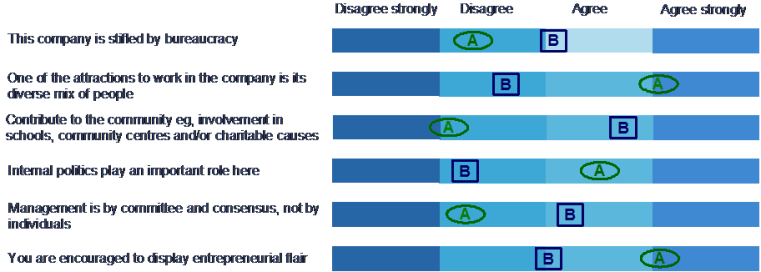
An interesting example of cultural change in a post merger integration project occurred in a transaction involving two retailers in Europe, spanning a number of countries but with a large base in the UK. In this case, the cultural barrier lay between two extremely well-aligned businesses – in other words, in the eyes of the employees, there was a strong linkage between the values which they themselves held and those of the business in which they worked. The potential was there for a very explosive situation as the businesses were significantly different in their approach. To give you some examples of the key difference, I’ve set out above some of the dimensions which we used to measure this difference. In each case, we asked the individuals we interviewed to mark on the spectrum where they saw their organisation (annotated as A and B). Some of the more startling results are seen in the graphic above.
What was fascinating was in certain dimensions where an external party might have seen an issue, for example ‘internal politics play an important role here’ or ‘the company is stifled by bureaucracy’, the individuals on the other hand, saw these as positive traits. ‘Internal politics’ were attributed to a management style which saw influence as a critical tool for changes to take place. In the case of ‘bureaucracy’, individuals considered that to be a key element in the collaborative and consultative nature of the business.
Another interesting result showing up the disparity between the two cultures was the question concerning entrepreneurial flair. For one organisation, this reflected a high degree of comfort with ‘ownership’ – many of the senior and middle management team had been owners of businesses which had been acquired by the company. Their willingness to take risks was based on that experience. For the other company, risk was seen as difficult and unattractive as the impact on the brand was unknown and potentially dangerous.
If these differences had not been addressed, the potential damage to the integration from a productivity perspective would have been very substantial.
The solutions in this case were fourfold:
1) The diagnostic (which had been conducted to get the above results) was communicated to a very broad audience, from executive board to each workstream. In each case, certain decisions were made around the operational implications of the different approaches. For example, at integration team level, agreement was reached on the level of consultation required for decisions. This was critical because the business needed to respond quickly and efficiently – individuals were asked to place themselves in various categories of ‘need to know’, which forced them to realise the nature of their role in the process of decision making. It also created an environment where ‘doing’ first and asking for forgiveness later was acceptable.
The process of releasing the information was in itself a solution. It provided employees at all levels with a sense of the leadership style going forward, and started to develop some trust.
2) The language used in the diagnostic was put into a corporate directory and distributed widely. For both technical and non-technical terms, there had been increasing levels of confusion about what each party meant when they used certain expressions and this helped to clarify. However, from a cultural perspective, certain terms became very helpful, non-pejorative descriptions of behaviour which employees from both businesses used and understood. At a board meeting a year later, the Finance Director used a couple of expressions directly from the diagnostic to explain certain performance characteristics – the fact that this language had transcended into financial management analysis on his part was very powerful for the organisation.
3) The diagnostic informed the process for developing senior executive long term incentive plans. Previously these plans had been created for a relatively small group of people whose interests were aligned. The process of broadening the schemes to have an impact on a group 3 or 4 times the size of the previous structure reflected a new culture within both businesses – one of personal accountability. Not only that, it also created the need for a more formal collaboration and alignment requirement in the combined business which was very important.
4) Finally, the attitude towards innovation and risk also changed considerably. This followed the successful launch of a new product which generated an exceptional return for the newly merged business. As the positive publicity surrounding this product increased internally and externally, a new found confidence towards developing ideas started to surface, and the perceived risk of entrepreneurial behaviour began to diminish.
To summarise, culture remains the key buzz word around transformation and post merger integration. How it is defined, its impact on successful implementation and on some of the solutions – all these aspects are becoming much more commonplace concepts amongst senior management. Ultimately however, there are still some considerable hurdles to deal with, before organisations see the ultimate value arising from culture-related activities.
The first hurdle is that diagnostic alone (particularly e-based diagnostic which has little human interaction) is interesting in a kind of ‘navel-gazing’ way but it needs more than that to make change happen…self-awareness through someone putting a mirror in front of you is a powerful thing, but there needs to be some clarity about what the future looks like. If you’re interested, you can read more about this in ‘To diagnose or not to diagnose’ on this blog.
The second hurdle is alignment. Part of any business strategy around major change or transformation is the need to include alignment – ask yourself these: how does my reward strategy reflect the performance I need from my senior management; does my induction programme deliver key messages at the start of a person’s employment which are aligned to the overall strategy; do the communication channels in themselves reflect how we, as a business, should be engaging with our employees and customers? Alignment challenges exist right across the board and the more aligned you can be, the greater the level of commitment, productivity and the retention of key staff you will achieve.
Finally, culture change and transformation / integration are about creating role models and myths or legends within the organisation. The power of a story compared with a mission statement is much more compelling, particularly if the story is related to an individual whom people have met or had opportunities to interact with. As an example, I have no doubt that the only things any reader of this blog might remember in a month might be some of the selected stories – and if so, it would be an achievement on my part.
Originally posted on BRAIN'S IDEA:
. But I’m a creep. I’m a weirdo. What the hell am I doing here? I don’t belong here. Why would anyone want to listen to this? Radiohead’s song Creep is not the exception in being a heartbreaking but nonetheless successful song. According to Wikipedia , of the ten best-selling music singles ever several are clearly sad songs: Elton John’s Candle in the…
I only wish I was accurate with my investments as with the timing of material in my blog! Below is a link to an article in the FT regarding the potential sale of Roland Berger, a mid sized strategy consultancy to PwC…it raises a bunch of very interesting integration issues…to do with the sale of a business whose only value is in its human capital. Potential value destruction disaster!!
Selling a consultancy is challenging and often not very financially rewarding. I’ve done it a couple of times and what looks like a great opportunity to generate some return for all the effort, is incredibly hard work and often not very lucrative. When you talk to advisers, they will talk about intellectual property a lot. A classic question would be, “what have you got which a buyer might be able […]
It is remarkable how bad many organisations are at something which is at the very heart of the human experience. We are all experts in communication, it is an activity which we live and breathe to such an extent that we’re mostly ‘doing’ it unconsciously. And yet, when it comes to our corporate life, there are very few times when the companies we work for, deliver clear, well written messages. […]
The Quiet Contemplation of Inactivity. Maybe it’s my age but there is so much in this that rings true for me…it’s brilliant and nostalgic, all in one!
Two consulting experiences with unexpected consequences: 1) You turn up at a client’s office usually from the back of a taxi with a colleague who’s been busy on something else, and the cab journey is the only preparation time you have for the meeting. Getting to an agreed agenda is almost the best you can expect from the time available and it’s with some trepidation that you walk into the […]
Originally posted on People-triggers:
“It ain’t so much the things we don’t know that get us into trouble, it’s the things we do know that just ain’t so.” —Mark Twain Some (very reputable) psychologists are absolutely convinced that DNA is destiny. Other (very reputable) psychologists are convinced that your personality is shaped by what happens to you as an infant – or perhaps even in the first few minutes of…
Like many of you reading this, I’m beholden to the clock….from a work perspective, time is the only key performance indicator which has commercial value in a consultants life. Everything else, like creativity, intuition, relationships and network, analytical ability, highly specialised knowledge about certain sectors or subsectors or processes or functions, or specific transformation events like mergers and acquisitions, is merely a precursor to the ultimate target, which is charging […]
The biological basis of orchestra seating. Amazing piece of research…interesting that the perspective of the player is the norm for set-up. I’m presuming that the further back one sits in the audience the more the effect is neutralised?
I’ve always struggled with the concept that these two dimensions should in some way be balanced. The definition of itself is wrong..the implication that work somehow isn’t part of life is surely incorrect? There’s also an implied assumption that these activities have a time equality on them in order to achieve that balance and that without this equality, our life is somehow reduced either in its value or in its […]
At the risk of promoting my old employer, they’ve just written an interesting piece on Chinese M&A into Europe…PricewaterhouseCoopers….worth checking out
Talk about the most pejorative of terms you’re ever likely to come across! Traditional corporate culture would have you believe that ‘hard’ things are factual, financial, real, rational. ‘Soft’ things are woolly, emotional, irrational, hard to prove, based on feelings and impressions rather than hard evidence. Soft things are easily manipulated, they’re the domain of the HR function, we’ll pay lip service to them but the real decisions get made […]
Originally posted on /'kül/:
I. There is nothing wrong with having a strong opinion. There is nothing wrong with writing a pointedly subjective review. In many ways, fiction is often more interesting to read–and sometimes more truthful, or enlightening–than non-fiction, because we tend to lower our guard around imaginary things that we expect can’t hurt us. (Consider the great psuedo-essay, The Lifespan of a Fact.) But none of this detracts…
Challenging the taboo subjects You know how it is sometimes, you’re in with a client and you unwittingly stumble upon a subject that generates a sharp intake of breath and a moment of silence. That’s often followed by statements like: “I wouldn’t go there if I were you”, “ that is a very sensitive issue and I’m not sure that we should follow that line of questioning”, “I understand that […]
I wasn’t born to be a consultant…who is? If any of you had met me as a child, you probably wouldn’t have noticed! My family background was extremely conservative, the attitude of ‘not speaking unless spoken to’ still prevailed to some extent and there was little opportunity to learn how to speak…you know, practice what worked and what didn’t work in an adult world. Like many kids, I was quiet, […]

